
Teaching Hell Is Child Abuse
The Deconstruction Fear Series: Five Fears That Keep Us From Questioning Our Faith

The Fears That Hold Us Back, Part One
Five Fears That Keep Us From Questioning Our Faith
Before we get into it, let me just say: I’m not here to tell you what to believe.
Whether you still believe in hell or you’ve already walked away from it—this series isn’t about convincing you. It’s about naming the fear that still lingers.
Because that fear—the one that whispers “But what if you’re wrong?”—doesn’t go away just because your beliefs shift.
It’s deep. Embodied. Learned young. Repeated often.
So in this five-part series, I want to walk through the five fears that keep many of us from fully questioning what we were taught.
And we’re starting with the loudest one:
The Fear of Hell.
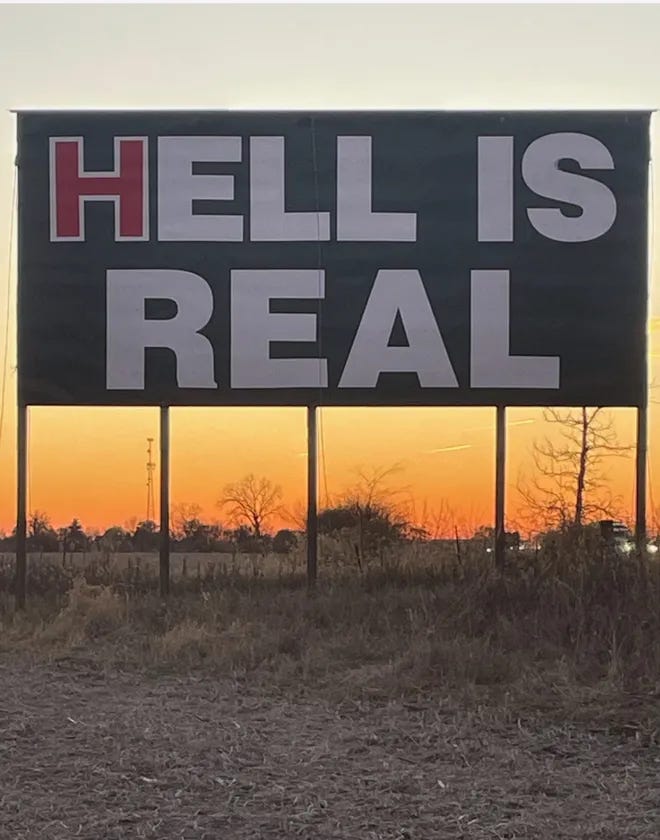
Let me start with something familiar—and strange:
Pascal’s Wager.
Blaise Pascal was a 17th-century French mathematician and philosopher who was trying to reason his way into belief. In his posthumously published Pensées, he proposed what became known as “Pascal’s Wager.”
The logic went like this:
It’s safer to believe in God—because if you’re wrong, and don’t believe, the consequences are eternal.
It’s basically spiritual insurance.
If you believe in God and you're wrong, no big deal.
But if you don’t believe and you’re wrong? Eternal damnation.
So belief becomes the “safer” bet.
I remember using this argument in high school with my non-church-going friends. I thought it was brilliant. Foolproof. Logic meets salvation.
But let’s be honest: it’s a weird reason to believe.
It’s not about truth or love. It’s about fear. And fear disguised as logic.
And once you step back, the whole thing crumbles.
Which God are you betting on, Blaise?
The Christian God? The Muslim God? Vishnu? Zeus?
The real God might be a cosmic dolphin named Gregg who just wanted you to recycle.
You might’ve wagered on the wrong one entirely.
Pascal’s Wager only works if there’s one God, one hell, and one correct answer.
And that’s not the world we live in.
But fear doesn’t care about logic.
Especially fear of hell.
For those of us raised in conservative Christianity, hell was the first fear we were handed. And often the last one to leave.
As someone who’s studied theology my whole life—both academically and personally—I’ll just say it:
I don’t believe in a literal hell.
And I think it’s a real stretch to get there from the teachings of Jesus.
In fact, I’ll go further.
Teaching children that if they believe the wrong thing they’ll burn forever isn’t just misinformed.
It’s child abuse.
And it creates very real trauma responses, long into adulthood.
I’ve written about this in depth in A Brief History of Hell, but here’s a quick summary of why, even as a Christian, I don’t believe in a literal hell anymore:
1. The Hebrew Scriptures don’t teach hell.
They describe Sheol—a shadowy grave where everyone goes. No fire. No torment. The afterlife in the Hebrew Scriptures is shadowy and undefined.
2. Jesus talked about Gehenna, not hell.
Gehenna was a valley on the edge of Jerusalem, historically associated with child sacrifice. That alone made it a symbol of destruction and shame.
By Jesus’ time, Gehenna wasn’t literally burning—but the memory of what had happened there was still smoldering. It had become a symbol of divine judgment and ruin.
So when Jesus says things like, “It’s better to lose your eye than have your whole body thrown into Gehenna,” he’s using a metaphor.
He’s not describing a supernatural underworld.
He’s using a cultural image his audience would’ve understood: a warning about destruction, corruption, and consequences.
3. Revelation is apocalyptic poetry.
The “lake of fire” shows up in a book full of dragons, beasts, angels dumping bowls of wrath, and multi-headed monsters.
To read Revelation as a literal forecast of the afterlife is, academically speaking, ridiculous.
It’s symbolic. Political. Poetic. And deeply Jewish in form.
The earliest Christians didn’t read Revelation the way many modern evangelicals do. And it almost didn’t even make it into the Bible—it was heavily contested for centuries.
Let’s not build our deepest fears out of an obscure ancient text just because we misunderstand it.
4. Hell comes more from Augustine (and Dante) than from Jesus.
Here’s something no one told me in Sunday School:
The idea of an eternal, conscious soul being judged and punished forever?
That doesn’t come from Jesus. Or Paul.
It comes from Augustine—the 4th-century church father who absorbed ideas from Greek philosophy (especially Plato) and reimagined them through a Christian lens.
In early Jewish and Christian thought, the big hope wasn’t about escaping to heaven or avoiding hell. It was resurrection. Renewal. A new heaven and a new earth.
But as Christianity spread into the Roman world, it absorbed new ideas: immortal souls, disembodied afterlives, and the belief that God’s justice meant eternal torment.
Augustine didn’t invent hell—but he made it central.
And a few centuries later, Dante made it unforgettable.
The Inferno painted hell in vivid detail. Every sin had its own ironic punishment. It was brilliant storytelling—and terrible theology.
But it stuck.
Hell became more about fear and control.
And the gospel became more about hell than Jesus.
5. Hell became a control tactic.
Let’s just name it:
Hell has been used to scare people into obedience for centuries.
It was used to raise money. To secure loyalty. To control behavior. To prop up political power. From indulgences in the Middle Ages to revivalist altar calls in the 20th century, fear of hell has been a key motivator.
But fear-based faith rarely produces transformation.
It produces anxiety. Shame. Suppression.
And even when people leave the belief, the fear can still linger.
But just because something was powerful doesn’t mean it was true.
And just because something was effective doesn’t mean it was good.
So… What If You’re Still Scared?
If you’ve (mostly) let go of belief in hell—but it still haunts you—please know this:
You’re not weak. You’re not being irrational.
You’re not failing at deconstruction.
You were handed this fear young.
Before your brain was fully developed.
Before you had a chance to think critically.
Before you even had language for why it didn’t feel right.
And it was handed to you by people you trusted. And loved.
That matters.
This fear isn’t just about ideas. It’s embodied.
It lives in the body. It shows up in your stomach. Your chest. Your nightmares.
That’s why it’s the first fear we’re covering.
Because for many of us, it was the first one planted—and the hardest to dig out.
What I Believe Now
I don’t know exactly what happens when we die.
I have hopes. I have instincts.
But I don’t believe in a literal hell at all.
Not because it stopped scaring me, but because I stopped seeing it as plausible on many levels.
Once I saw where the idea came from—poets, preachers, empires, and fear—I just couldn’t unsee it.
Now, I believe that love is a better motivator than fear.
That curiosity is more sustainable than certainty.
And that no God worthy of worship would torture people for eternity for being born in the wrong zip code. Or unable to believe something just to cover their bases.
If all this still leaves you uneasy, that’s okay.
It takes time to recover from trauma.
Take all the time you need.
All I can tell you is that I’ve seen countless people leave this belief—and replace fear with peace. I do wish that for you.
I refuse to believe that our core beliefs are best decided on as a savvy gambler.
Or as a fearful child.
Your questions won’t condemn you to a literal hell.
But ignoring them for too long might make it feel like you’re in one now.
Gregg in all of his glory. Place your wagers:

I really want Gregg to be real mostly because I love dolphins (who doesn't though) and if dolphins don't exist in whatever afterlife is next I want no part in it. 😂 🐬 In all seriousness though, everything you said in this makes sense. I like the idea of Sheol over a literal hell any day.
On top of all that, no one believes something because of consequences. Threats don’t produce belief, only pretense. People believe something because they think it’s true. If you threaten someone with hell if they don’t believe something and they think the threat is real, they will pretend to believe. You think God doesn’t see through that? When people used that argument with me when I rejected God in high school, I thought they were revealing stupidity.